Fearless Females Blog Post: March 17: Social Butterfly?

March 17 — Social Butterfly? What social organizations or groups did your mother or grandmother belong to? Sewing circle, church group, fraternal benefit society or lodge? Describe her role in the group.


[Note: This post originally ran during the Fearless Females series in March 2010]

My mother and grandmothers socialized mostly with their neighbors or friends they knew from church. My mother belonged to the Ladies Penna. Slovak Catholic Union and the Roman Catholic Parochial Beneficial Society of Rosary of the Blessed Virgin.


When our immigrant ancestors arrived in the New World, they often settled in enclaves within cities and towns and tended to cluster in specific regions in the United States. It was common for immigrants, particularly those who did not speak English, to travel together and put down roots among relatives, friends, or neighbors from their native land. These so-called “cluster communities” offered a place where the immigrants could transplant and preserve their culture, lifestyle and traditions as best they could in their new surroundings. Seeking to keep their culture as it existed in the homeland, immigrant groups frequently founded their own churches, schools, boarding houses, and other institutions, as well as forming their own academic, athletic, or charitable groups, and fraternal, occupational, and social organizations. Many also established their own ethnic presses that published newspapers and histories to highlight specific communities. In the late 1800s, fraternal organizations became very popular. Employed largely in difficult and often dangerous industrial occupations, immigrants sought financial protection for themselves and their families. As a result, they established their own fraternal/benevolent organizations to provide mutual insurance and to foster camaraderie and social interaction, and some even as a way to keep ties to traditions or ways of the old country. Today, we have the Internet. For my parents and grandparents, these fraternal benefit societies and lodges provided the “social networking” opportunities.


Copyright, 2013, Lisa A. Alzo
All Rights Reserved

http://theaccidentalgenealogist.blogspot.com/atom.xml

Fearless Females Blog Post: March 14: In the News

March 14 — Newsmakers? Did you have a female ancestor who made the news? Why? Was she famous or notorious? Did she appear in the social column?

[Note: This post originally ran during the Fearless Females series in March 2010]

My ancestors were working class immigrants so there wasn’t much of a chance for them to appear in the social columns of the local newspapers. I have mounted copy of my paternal grandmother’s obituary from 1966 that appeared in the Daily News in McKeesport, PA. The funeral home provided it to the family.


Copyright, 2013, Lisa A. Alzo
All Rights Reserved


http://theaccidentalgenealogist.blogspot.com/atom.xml

Fearless Females Blog Post: March 10: Religion

March 10 — What role did religion play in your family? How did your female ancestors practice their faith? If they did not, why didn’t they? Did you have any female ancestors who served their churches in some capacity?


[Note: This post originally ran during the Fearless Females series in March 2010]
Both of my grandmothers had a deep faith in God. Both were baptized in the Greek Catholic rite. After coming to America, my dad’s mother married in the Greek Catholic church but then followed her husband to the Roman Catholic church. My maternal grandmother attending the Greek Catholic church in America but then switched to Russian Orthodox. By doing so, she was then able to continue to observe Christmas on January 7th.


My dad’s sister (my “Auntie”–who kept the scrapbook I wrote about in my March 8th post) was a Roman Catholic nun–she spent most of her adult life in a convent in Victoria, Texas. Our family always looked forward to her visits–usually at Christmas and for a few weeks in the summer. Here is a photograph of her once she took the name of Sr. M. Camilla.


Photos from the Alzo family collection. Held for private use by Lisa A.Alzo, Ithaca, New York.
Copyright, 2013, Lisa A. Alzo
All rights reserved

http://theaccidentalgenealogist.blogspot.com/atom.xml

Fearless Females Blog Post: March 8: Diaries, Letters, and Journals

March 8 — Did one of your female ancestors leave a diary, journal, or collection of letters? Share an entry or excerpt.

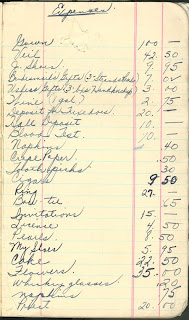
I don’t have any diaries or journals from any of my female ancestors. I do have one keepsake from my mother–a notebook she kept while planning her wedding in 1947.


In this notebook, she kept a detailed description of all the things she purchased for the big day–from the rings, to the blood test, to how many pounds of ground meat for the stuffed cabbage to be served at the reception! She noted in detail how much each item cost. My mother was meticulous when it came to keeping track of expenses and good at math. I love looking at this book–it reveals so much about my mother’s personality.


Copyright, 2013, Lisa A. Alzo
All Rights Reserved

http://theaccidentalgenealogist.blogspot.com/atom.xml

Fearless Females Blog Post: March 5: How They Met

March 5 — How did they meet? You’ve documented marriages, now, go back a bit. Do you know the story of how your parents met? Your grandparents?

[Note: This post originally ran during the Fearless Females series in March 2010]

My parents met when my father returned home from serving in the Navy during World War II. My mother’s family had moved next door to his family and my mother was friends with his sister, Betty. Betty and her husband John would take their son Jackie to the park or zoo and my mother would go along. When my father came home from the service he went on the outings too and then the two started dating. My parents fell short of celebrating 53 years of marriage—my mother passed away a month before their anniversary. My mother’s parents had an arranged marriage. As the story goes, my grandfather was working in the coal mines of Fairpoint, Ohio and was friends with my grandmother’s brother-in-law. My grandfather was looking for a bride who was literally just “getting off the boat” and his friend John said his wife’s sister was soon coming to America and set the two up. My dad’s parents met at the boarding house my grandmother’s sister, Mary, managed in Duquesne, PA, when he was working in the steel mill there.

Copyright, 2013, Lisa A. Alzo
All rights reserved
http://theaccidentalgenealogist.blogspot.com/atom.xml

Fearless Females Blog Post: March 1 – Favorite Female Ancestor

March 1 — Do you have a favorite female ancestor? One you are drawn to or want to learn more about? Write down some key facts you have already learned or what you would like to learn and outline your goals and potential sources you plan to check.

This year I’m still trying to learn more about my great-grandmother, Borbala Manovsky Alzo. I listed her as one of my “Family History Three” in a post back in January 2011.


I know very little about her so hope to find out whatever I can. She died in 1961–the same year (just a few months apart) as her son (my grandfather), and I thought this was an interesting coincidence. I have her marriage record thanks to my cousin. I also have some pictures from her funeral. From family I learned that she had several sisters so I’d like to learn more about them too. I am in the processing of doing more research and am hoping to obtain a copy of her death record from Slovakia, and hopefully will be able  to find some other documents, as well.


Copyright, 2013, LIsa A. Alzo
All rights reserved
http://theaccidentalgenealogist.blogspot.com/atom.xml

Fearless Females Blog Post: March 30: Words of Wisdom

March 30 — Did you receive any advice or words of wisdom from your mother or another female ancestor?

[Note: This post originally ran during the Fearless Females series in March 2010]


My mother taught me to believe in myself and that just because someone else had more money, more advantages, or more opportunities that I shouldn’t feel they were better than me, or that this made me less of a person. She also taught me not to give up just because something seemed difficult or impossible to accomplish. Mom was a very smart woman and while at the time I couldn’t understand the lessons or principles she was trying to teach, I can truly appreciate them now.

Copyright, 2012, Lisa A. Alzo

All Rights Reserved

http://theaccidentalgenealogist.blogspot.com/atom.xml

Fearless Females Blog Post: March 29: Honoring a Female Ancestor

March 29 — Create a free Fold3 (formerly Footnote) Memorial Page or a Genealogy Trading Card at Big Huge Labs for a female ancestor. Some of you may have created your own card back in September 2009 following Sheri Fenley’s post over at The Educated Genealogist. This time, the card is for your ancestor.


[Note: This post originally ran during the Fearless Females series in March 2010]


I chose to create a free Fold3 Page for Elizabeth Alzo (my grandmother). I used data from the Footnote database to help build the page – there are links to the 1930 census entry for her and to her naturalization petitions. I also added an image of her obituary, and plan to add some stories, and more information down the line.


Copyright, 2012, Lisa A. Alzo

All Rights Reserved

http://theaccidentalgenealogist.blogspot.com/atom.xml

Fearless Females Blog Post: March 26: Education

March 26 — What education did your mother receive? Your grandmothers? Great-grandmothers? Note any advanced degrees or special achievements.


[Note: Portions of this post originally ran during the Fearless Females series in March 2010]]


My mother graduated from high school but did not go to college (her parents could not afford it). Mom was very smart and good at math. But she went to work after high school and after she married my father worked part time. I think she sometimes regretted not being able to go to college, and she worked very hard to make sure I was able to, and was so proud that I went to graduate school to earn my M.F.A. degree.


My grandmothers each had what was likely the equivalent of an 8th grade education, but by no means were they unintelligent women. They were at a disadvantage being immigrants and, but somehow they managed their households, raised their children, were able to hold down jobs speaking very little English.


Copyright, 2012, Lisa A. Alzo
All Rights Reserved
http://theaccidentalgenealogist.blogspot.com/atom.xml